
 English
 Afrikaans
 Albanian
 Amharic
 Arabic
 Armenian
 Azerbaijani
 Basque
 Belarusian
 Bengali
 Bosnian
 Bulgarian
 Catalan
 Cebuano
 Chichewa
 Chinese (Simplified)
 Chinese (Traditional)
 Corsican
 Croatian
 Czech
Czech Danish
 Dutch
Dutch Esperanto
 Estonian
 Filipino
 Finnish
 French
 Frisian
 Galician
 Georgian
 German
 Greek
Greek Gujarati
 Haitian Creole
 Hausa
Hausa Hawaiian
 Hebrew
 Hindi
Hindi Hmong
Hmong Hungarian
 Icelandic
 Igbo
Igbo Indonesian
 Irish
Irish Italian
 Japanese
 Javanese
 Kannada
 Kazakh
 Khmer
Khmer Korean
 Kurdish (Kurmanji)
 Kyrgyz
 Lao
Lao Latin
Latin Latvian
 Lithuanian
 Luxembourgish
 Macedonian
 Malagasy
 Malay
Malay Malayalam
 Maltese
 Maori
Maori Marathi
 Mongolian
 Myanmar (Burmese)
 Nepali
 Norwegian
 Pashto
 Persian
 Polish
 Portuguese
 Punjabi
 Romanian
 Russian
 Samoan
 Scottish Gaelic
 Serbian
 Sesotho
 Shona
Shona Sindhi
 Sinhala
 Slovak
 Slovenian
 Somali
 Spanish
 Sudanese
 Swahili
 Swedish
 Tajik
Tajik Tamil
Tamil Telugu
 Thai
Thai Turkish
 Ukrainian
 Urdu
Urdu Uzbek
Uzbek Vietnamese
 Welsh
Welsh Xhosa
Xhosa Yiddish
 Yoruba
 Zulu
Zulu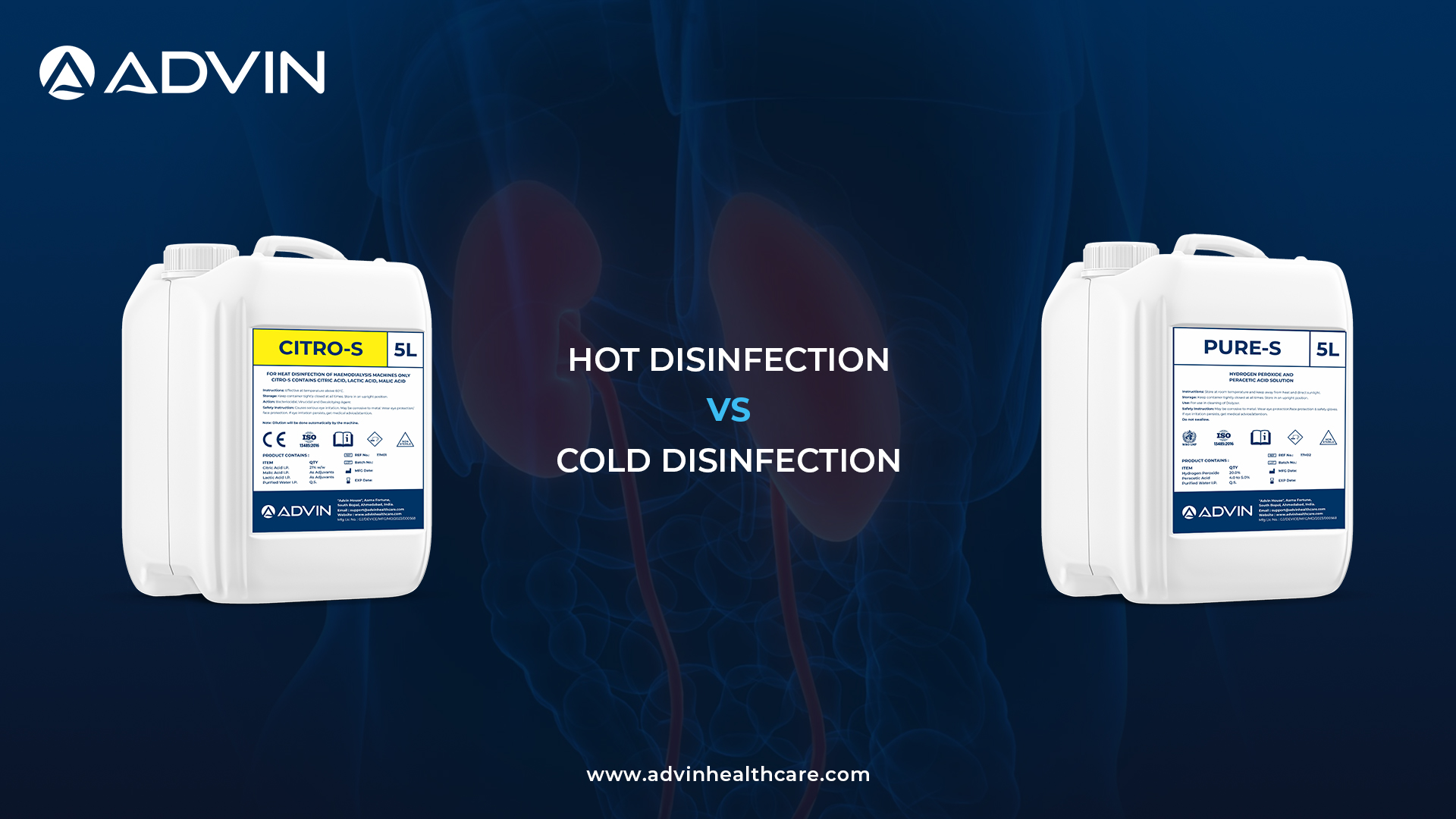
In healthcare settings—especially in dialysis centers—maintaining strict hygiene standards is critical to ensure patient safety and optimal equipment performance. Disinfection plays a vital role in preventing infections, and two commonly used methods are hot disinfection and cold disinfection.
Understanding the differences between these methods helps healthcare providers choose the most effective and safe approach.
What is Hot Disinfection?
- Hot disinfection is a process that uses high-temperature water (typically between 80°C and 95°C) to eliminate microorganisms from medical equipment, such as dialysis machines and fluid pathways.
- Modern dialysis machines are often equipped with automated hot disinfection systems, making the process efficient and reliable for routine use.
Benefits of Hot Disinfection
- Highly effective against bacteria and most viruses
- Chemical-free process, leaving no harmful residues
- Safer for patients and staff due to absence of toxic chemicals
- Cost-effective over time, as it reduces chemical consumption
Limitations
- Requires advanced equipment with heating capability
- May not eliminate certain heat-resistant spores
- Involves higher energy consumption
What is Cold Disinfection?
- Cold disinfection involves the use of chemical disinfectants at room temperature to kill microorganisms. It is widely used in facilities where hot disinfection is not available or as a supplementary method.
- Common disinfectants include peracetic acid, formaldehyde, sodium hypochlorite, and glutaraldehyde.
Benefits of Cold Disinfection
- Broad-spectrum effectiveness, including some resistant organisms
- Suitable for older equipment without heating systems
- Lower energy requirement compared to hot disinfection
Limitations
- Risk of chemical residues if rinsing is inadequate
- Requires careful handling and safety protocols
- Can lead to equipment wear or corrosion over time
- Typically involves longer processing time
Key Differences Between Hot and Cold Disinfection
| Feature | Hot Disinfection | Cold Disinfection |
| Method | High-temperature water | Chemical agents |
| Temperature | 80°C – 95°C | Room temperature |
| Residue Risk | None | Possible |
| Effectiveness | Bacteria & viruses | Broad (including some spores) |
| Equipment Required | Advanced machines | Standard equipment |
| Safety | High | Requires precautions |
| Operating Cost | Lower (long-term) | Higher (chemical recurring) |
Which Method is Better?
There is no one-size-fits-all answer. In practice:
- Hot disinfection is ideal for daily routine cleaning, offering a safe and residue-free process.
- Cold disinfection is often used for periodic deep disinfection or when dealing with resistant microorganisms.
Most modern healthcare facilities adopt a combined approach, using both methods to ensure maximum infection control and compliance with safety standards.
Conclusion
Both hot and cold disinfection methods play essential roles in healthcare hygiene management. While hot disinfection provides a safer and more convenient solution for routine use, cold disinfection remains valuable for its broad-spectrum effectiveness.
Choosing the right method—or a combination of both—ensures not only compliance with hygiene protocols but also enhances patient safety and extends the life of medical equipment.
Get Connected:
+91-75037 27249 | dialysis@advinhealthcare.com | www.advinhealthcare.com