 English
 Afrikaans
 Albanian
 Amharic
 Arabic
 Armenian
 Azerbaijani
 Basque
 Belarusian
 Bengali
 Bosnian
 Bulgarian
 Catalan
 Cebuano
 Chichewa
 Chinese (Simplified)
 Chinese (Traditional)
 Corsican
 Croatian
 Czech
Czech Danish
 Dutch
Dutch Esperanto
 Estonian
 Filipino
 Finnish
 French
 Frisian
 Galician
 Georgian
 German
 Greek
Greek Gujarati
 Haitian Creole
 Hausa
Hausa Hawaiian
 Hebrew
 Hindi
Hindi Hmong
Hmong Hungarian
 Icelandic
 Igbo
Igbo Indonesian
 Irish
Irish Italian
 Japanese
 Javanese
 Kannada
 Kazakh
 Khmer
Khmer Korean
 Kurdish (Kurmanji)
 Kyrgyz
 Lao
Lao Latin
Latin Latvian
 Lithuanian
 Luxembourgish
 Macedonian
 Malagasy
 Malay
Malay Malayalam
 Maltese
 Maori
Maori Marathi
 Mongolian
 Myanmar (Burmese)
 Nepali
 Norwegian
 Pashto
 Persian
 Polish
 Portuguese
 Punjabi
 Romanian
 Russian
 Samoan
 Scottish Gaelic
 Serbian
 Sesotho
 Shona
Shona Sindhi
 Sinhala
 Slovak
 Slovenian
 Somali
 Spanish
 Sudanese
 Swahili
 Swedish
 Tajik
Tajik Tamil
Tamil Telugu
 Thai
Thai Turkish
 Ukrainian
 Urdu
Urdu Uzbek
Uzbek Vietnamese
 Welsh
Welsh Xhosa
Xhosa Yiddish
 Yoruba
 Zulu
Zulu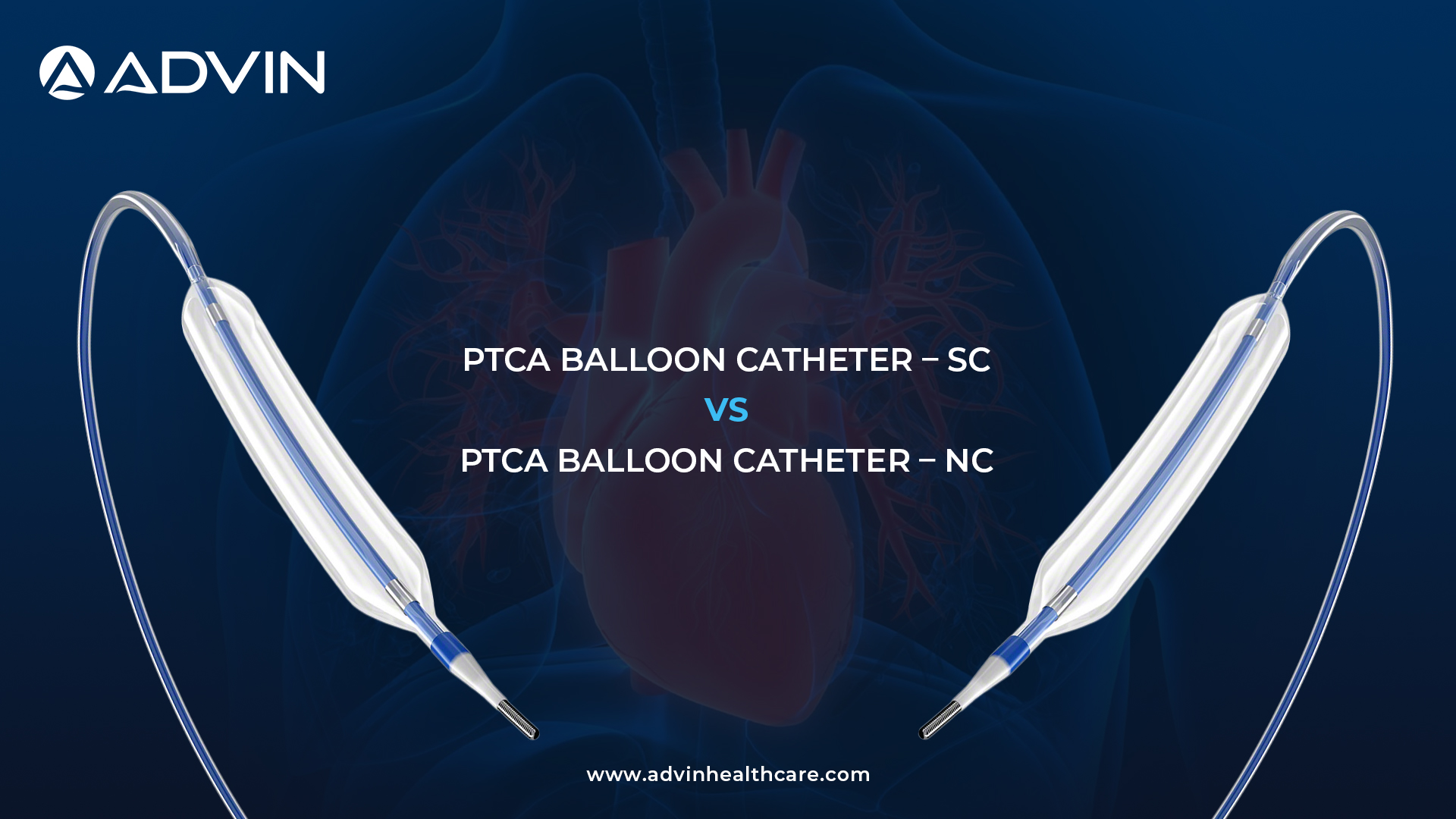
Introduction
In interventional cardiology, PTCA balloon catheters are essential tools used during angioplasty procedures to dilate blocked or narrowed coronary arteries. Among the most commonly used types are the PTCA Balloon Catheter – SC (Semi-Compliant) and PTCA Balloon Catheter – NC (Non-Compliant).
While both are designed to restore blood flow, they differ in behavior, control, and clinical application. Understanding these differences helps clinicians choose the most appropriate balloon for specific procedural needs.
Product Overview
PTCA Balloon Catheter – SC
The Semi-Compliant (SC) PTCA Balloon Catheter is designed to provide flexibility and adaptability during angioplasty. It can slightly expand beyond its nominal size, making it suitable for navigating variable vessel conditions.
PTCA Balloon Catheter – NC
The Non-Compliant (NC) PTCA Balloon Catheter is designed for precise and controlled dilation. It maintains its shape and size even under pressure, making it ideal for high-precision interventions.
Quick Comparison Table
| Feature | PTCA Balloon Catheter – SC | PTCA Balloon Catheter – NC |
|---|---|---|
| Balloon Behavior | Flexible expansion | Controlled expansion |
| Adaptability | High | Low |
| Precision | Moderate | High |
| Pressure Handling | Moderate | High |
| Vessel Conformity | Better | Limited |
| Clinical Use | Initial dilation | Post-dilation / optimization |
Key Feature Comparison
- Balloon Compliance
The SC balloon is semi-compliant, meaning it can adjust slightly to vessel size and shape during inflation. In contrast, the NC balloon is non-compliant, maintaining a fixed size for precise dilation.
- Precision & Control
SC balloons provide flexibility but less precision compared to NC balloons. NC balloons offer superior control, ensuring accurate expansion without over-dilation.
- Adaptability to Vessel Anatomy
SC balloons adapt better to irregular or tapered vessels, making them useful in varied anatomical conditions. NC balloons are less adaptive but provide consistent performance in controlled environments.
- Pressure Performance
SC balloons are suitable for moderate pressure applications. NC balloons are designed to withstand higher pressures, making them ideal for resistant lesions.
- Procedural Role
SC balloons are typically used in the initial stage of angioplasty to pre-dilate lesions. NC balloons are used in later stages for post-dilation and optimization of stent placement.
Common Features
Both balloon catheters share essential features
- Designed for effective coronary artery dilation
- Enable smooth navigation through vascular pathways
- Compatible with standard angioplasty procedures
- Provide reliable performance during interventions
- Support controlled inflation and deflation
- Sterile, single-use design for patient safety
Key Differences
- Expansion Type: Flexible vs Controlled
- Precision Level: Moderate vs High
- Pressure Capability: Moderate vs High
- Adaptability: High vs Low
- Usage Stage: Pre-dilation vs Post-dilation
Which One Should You Choose?
Choose PTCA Balloon Catheter – SC when
- Initial lesion dilation is required
- Vessel anatomy is variable or complex
- Flexibility and adaptability are needed
Choose PTCA Balloon Catheter – NC when
- Precise dilation is critical
- High-pressure application is required
- Stent optimization or post-dilation is needed
Conclusion
Both PTCA Balloon Catheter – SC and PTCA Balloon Catheter – NC play important roles in angioplasty procedures. The SC balloon is ideal for flexible and adaptive dilation, while the NC balloon ensures precise and controlled expansion.
Using the right type of balloon at the right stage of the procedure improves efficiency, enhances accuracy, and leads to better clinical outcomes.
Get Connected:
+91-75037 27248 | cardiology@advinhealthcare.com | www.advinhealthcare.com