
 English
 Afrikaans
 Albanian
 Amharic
 Arabic
 Armenian
 Azerbaijani
 Basque
 Belarusian
 Bengali
 Bosnian
 Bulgarian
 Catalan
 Cebuano
 Chichewa
 Chinese (Simplified)
 Chinese (Traditional)
 Corsican
 Croatian
 Czech
Czech Danish
 Dutch
Dutch Esperanto
 Estonian
 Filipino
 Finnish
 French
 Frisian
 Galician
 Georgian
 German
 Greek
Greek Gujarati
 Haitian Creole
 Hausa
Hausa Hawaiian
 Hebrew
 Hindi
Hindi Hmong
Hmong Hungarian
 Icelandic
 Igbo
Igbo Indonesian
 Irish
Irish Italian
 Japanese
 Javanese
 Kannada
 Kazakh
 Khmer
Khmer Korean
 Kurdish (Kurmanji)
 Kyrgyz
 Lao
Lao Latin
Latin Latvian
 Lithuanian
 Luxembourgish
 Macedonian
 Malagasy
 Malay
Malay Malayalam
 Maltese
 Maori
Maori Marathi
 Mongolian
 Myanmar (Burmese)
 Nepali
 Norwegian
 Pashto
 Persian
 Polish
 Portuguese
 Punjabi
 Romanian
 Russian
 Samoan
 Scottish Gaelic
 Serbian
 Sesotho
 Shona
Shona Sindhi
 Sinhala
 Slovak
 Slovenian
 Somali
 Spanish
 Sudanese
 Swahili
 Swedish
 Tajik
Tajik Tamil
Tamil Telugu
 Thai
Thai Turkish
 Ukrainian
 Urdu
Urdu Uzbek
Uzbek Vietnamese
 Welsh
Welsh Xhosa
Xhosa Yiddish
 Yoruba
 Zulu
Zulu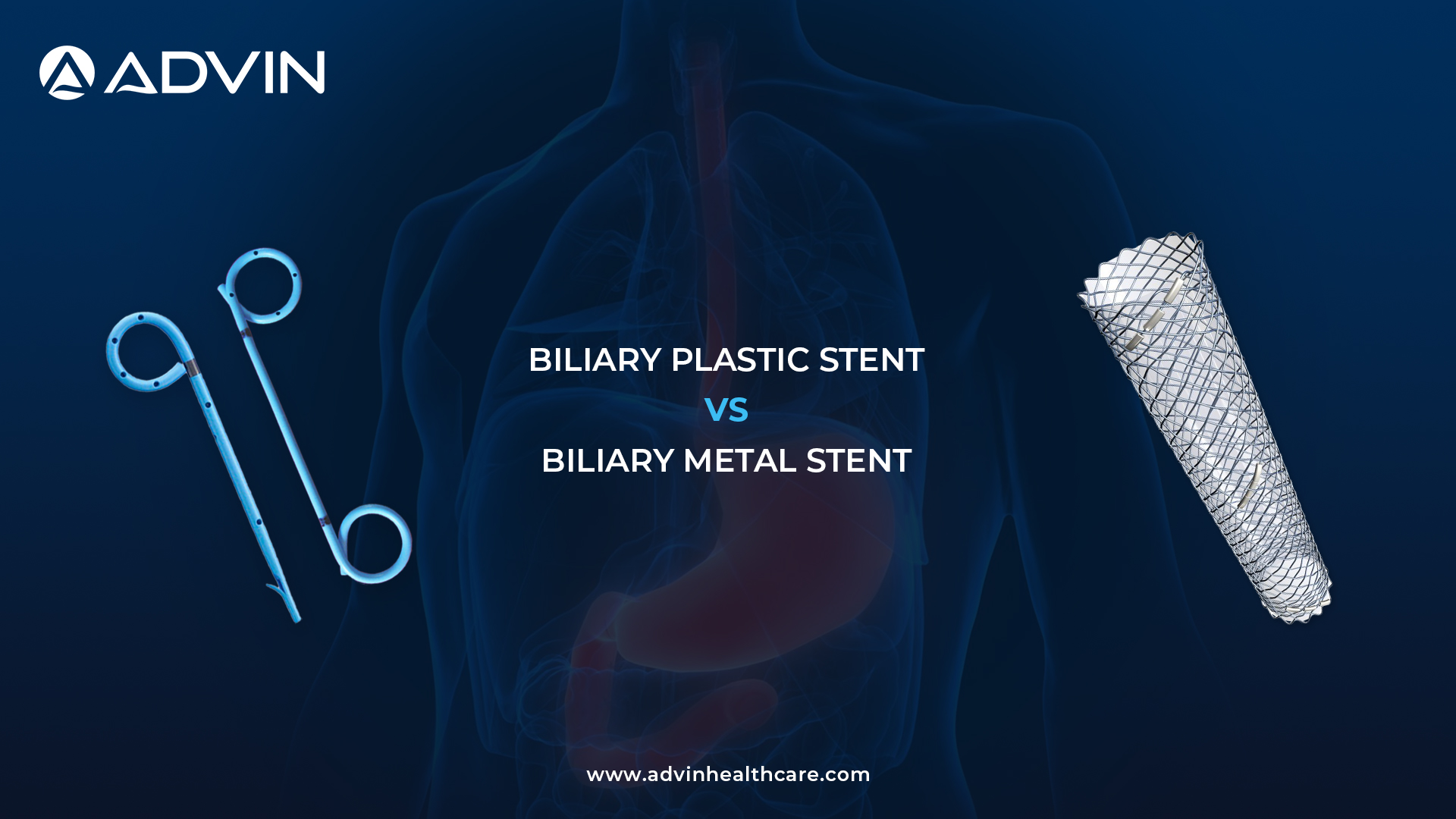
Introduction: Clinical Decision Beyond Material
Biliary stenting is a routine yet critical part of ERCP procedures, used to relieve obstruction and restore bile flow. Both Biliary Plastic Stents and Biliary Metal Stents are widely used, but their selection depends on treatment duration, diagnosis, and patient condition. During ERCP, a stent is placed across a stricture or blockage to ensure continuous drainage from the bile duct into the intestine.
While both serve the same purpose, their performance and lifecycle differ significantly. Understanding these differences helps clinicians plan better and improves long-term patient management.
Product Overview in Clinical Use
Biliary Plastic Stent (ERCP Plastic Stent System)
Advin Health Care’s Biliary Plastic Stents are designed for short-term to medium-term biliary drainage. These stents are made from medical-grade polymer and are available in multiple configurations to suit different anatomical needs:
- Straight Stent – commonly used for routine drainage
- Double Pigtail Stent – reduces migration risk with curled ends
- Single Pigtail Stent – offers partial anchoring
- Amsterdam Type – flanged design for stability
- Pancreatic Type – smaller size for pancreatic duct use
They are easy to insert and remove, making them ideal for temporary or staged treatment plans.
Biliary Metal Stent (Self-Expanding Metal Stent – SEMS)
Advin Health Care’s Biliary Metal Stents are built for long-term drainage, especially in complex or malignant cases. Made from nitinol, these stents expand after placement to maintain a wider lumen. Types include:
- Fully Covered SEMS – prevents tissue ingrowth and allows removal
- Partially Covered SEMS – balances fixation and removability
- Uncovered SEMS – integrates with tissue for strong positioning
These stents are typically used when long-lasting patency is required.
Core Differences That Drive Clinical Choice
The key difference lies in duration and performance under pressure.
Plastic stents are flexible and cost-effective but may clog over time, requiring replacement. Metal stents offer a larger expanded diameter, ensuring longer patency and fewer repeat procedures.
Quick Comparison Overview
| Aspect | Biliary Plastic Stent | Biliary Metal Stent |
| Material | Polymer | Nitinol |
| Patency | Short to medium | Long-term |
| Diameter | Smaller | Expands to larger size |
| Cost | Economical | Higher upfront |
| Replacement | Frequent | Less frequent |
| Removability | Easy | Type-dependent |
| Usage | Benign / temporary | Malignant / long-term |
Clinical Preference & Real-World Application
Advin Biliary Plastic Stents are widely used in benign biliary conditions, post-stone removal, or when repeat access is expected. Their flexibility and ease of exchange make them suitable for ongoing management.
Advin Biliary Metal Stents are preferred in malignant strictures, where maintaining duct patency over a longer period is essential. They reduce the need for repeated interventions and support continuous drainage.
Why Advin Health Care is the Right Choice
Advin Health Care provides a complete biliary stent range designed for consistent performance across diverse clinical needs. Advin Plastic Stents ensure smooth insertion and reliable drainage in routine cases.
Advin Health Care’s Metal Stents are engineered for controlled expansion and sustained lumen support in complex conditions. With Advin, healthcare providers benefit from dependable quality, versatile options, and solutions tailored for both short-term and long-term biliary care.
Get Connected:
+91-75037 27250 | gastrology@advinhealthcare.com | www.advinhealthcare.com