
 English
 Afrikaans
 Albanian
 Amharic
 Arabic
 Armenian
 Azerbaijani
 Basque
 Belarusian
 Bengali
 Bosnian
 Bulgarian
 Catalan
 Cebuano
 Chichewa
 Chinese (Simplified)
 Chinese (Traditional)
 Corsican
 Croatian
 Czech
Czech Danish
 Dutch
Dutch Esperanto
 Estonian
 Filipino
 Finnish
 French
 Frisian
 Galician
 Georgian
 German
 Greek
Greek Gujarati
 Haitian Creole
 Hausa
Hausa Hawaiian
 Hebrew
 Hindi
Hindi Hmong
Hmong Hungarian
 Icelandic
 Igbo
Igbo Indonesian
 Irish
Irish Italian
 Japanese
 Javanese
 Kannada
 Kazakh
 Khmer
Khmer Korean
 Kurdish (Kurmanji)
 Kyrgyz
 Lao
Lao Latin
Latin Latvian
 Lithuanian
 Luxembourgish
 Macedonian
 Malagasy
 Malay
Malay Malayalam
 Maltese
 Maori
Maori Marathi
 Mongolian
 Myanmar (Burmese)
 Nepali
 Norwegian
 Pashto
 Persian
 Polish
 Portuguese
 Punjabi
 Romanian
 Russian
 Samoan
 Scottish Gaelic
 Serbian
 Sesotho
 Shona
Shona Sindhi
 Sinhala
 Slovak
 Slovenian
 Somali
 Spanish
 Sudanese
 Swahili
 Swedish
 Tajik
Tajik Tamil
Tamil Telugu
 Thai
Thai Turkish
 Ukrainian
 Urdu
Urdu Uzbek
Uzbek Vietnamese
 Welsh
Welsh Xhosa
Xhosa Yiddish
 Yoruba
 Zulu
Zulu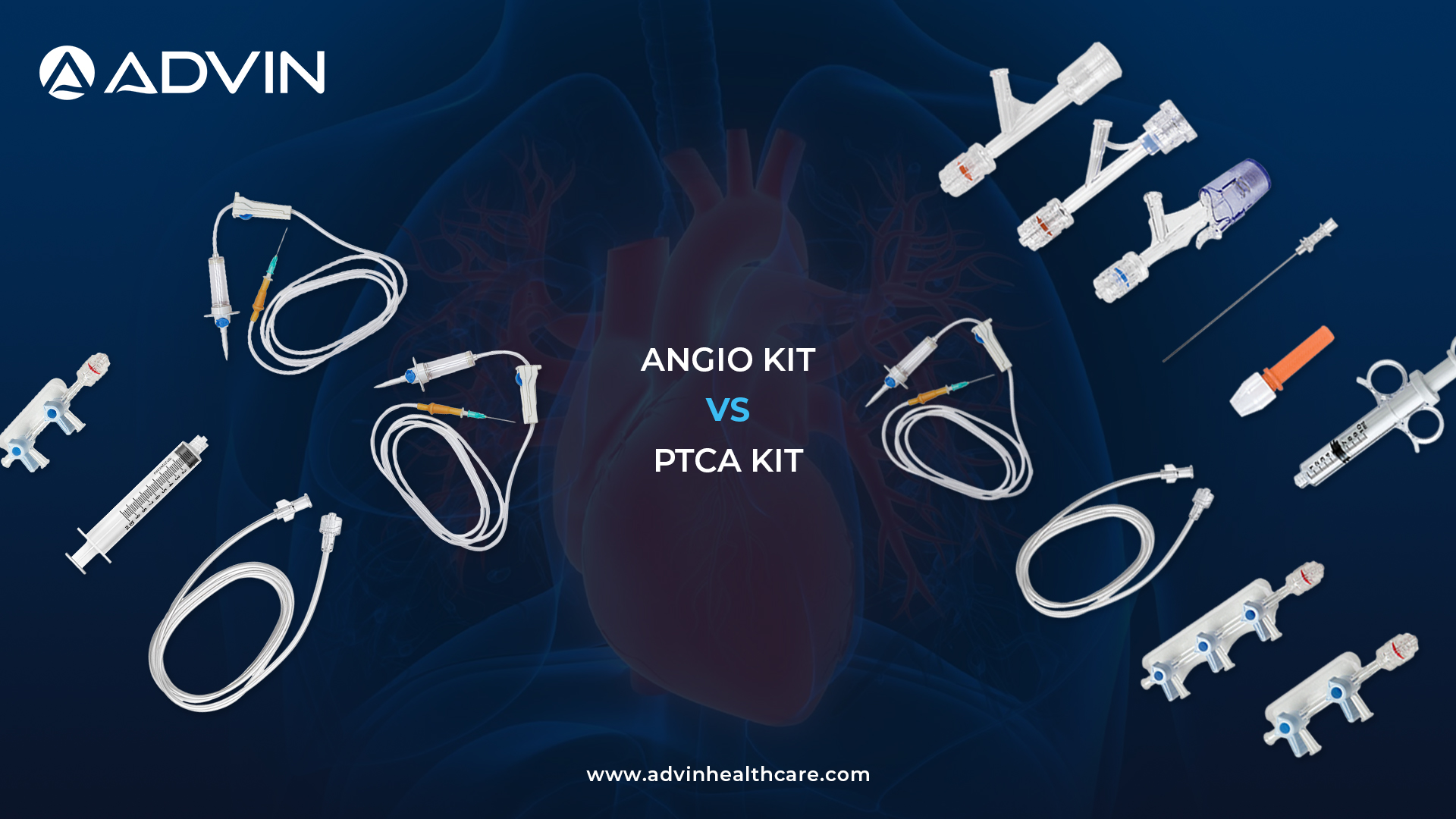
Angio Kit vs PTCA Kit: Understanding the Difference in Cardiology Procedure Kits
Introduction
In interventional cardiology, procedure-specific kits play a crucial role in ensuring efficiency, safety, and smooth workflow. Two commonly used kits are the Angio Kit and the PTCA Kit.
While both kits are designed to support cardiovascular procedures, they are used at different stages—one for diagnosis and the other for treatment. Understanding their features and differences helps healthcare professionals select the right kit for optimal procedural outcomes.
Product Overview
Angio Kit
The Angio Kit is designed for diagnostic procedures such as coronary angiography. It includes essential components required to visualize blood vessels and assess blockages using contrast media.
PTCA Kit
The PTCA (Percutaneous Transluminal Coronary Angioplasty) Kit is used for interventional procedures. It contains components that assist in treating blocked arteries by supporting device delivery and procedural control.
Quick Comparison Table
| Feature | Angio Kit | PTCA Kit |
| Primary Purpose | Diagnosis | Treatment |
| Procedure Type | Angiography | Angioplasty / PCI |
| Function | Vessel imaging | Device support & intervention |
| Workflow Stage | Initial diagnosis | Therapeutic stage |
| Complexity Handling | Standard | Advanced |
| Clinical Use | Identifying blockages | Treating blockages |
Key Feature Comparison
- Purpose & Application
The Angio Kit is used to diagnose cardiovascular conditions by enabling visualization of coronary arteries. In contrast, the PTCA Kit is used to treat these conditions through interventional procedures.
- Procedure Stage
Angio Kits are used at the beginning of the procedure for assessment and diagnosis. PTCA Kits are used after diagnosis when treatment, such as angioplasty, is required.
- Functional Capability
Angio Kits focus on imaging and evaluation. PTCA Kits are designed for active intervention, supporting the use of devices like balloons and stents.
- Workflow Efficiency
Angio Kits streamline diagnostic procedures by providing essential tools in one set. PTCA Kits enhance procedural efficiency during treatment by ensuring all necessary interventional components are readily available.
- Clinical Role
Angio Kits help in identifying the severity and location of blockages. PTCA Kits enable clinicians to perform corrective procedures to restore blood flow.
Common Features
Both kits share important advantages
- Provide organized and efficient procedure setup
- Include essential components for cardiology procedures
- Support smooth and controlled workflow
- Compatible with standard interventional techniques
- Reduce preparation time during procedures
- Sterile, single-use design for enhanced safety
Key Differences (Easy to Understand)
- Purpose: Diagnosis vs Treatment
- Usage Stage: Initial vs Interventional
- Function: Imaging vs Device-based intervention
- Complexity: Standard vs Advanced procedures
- Clinical Role: Detection vs Correction
Which One Should You Choose?
Choose Angio Kit when
- Performing diagnostic angiography
- Evaluating coronary artery conditions
- Identifying blockages before treatment
Choose PTCA Kit when
- Performing angioplasty or PCI
- Treating blocked arteries
- Interventional procedure is planned
Conclusion
- Both the Angio Kit and PTCA Kit are essential in modern cardiology workflows. The Angio Kit plays a vital role in diagnosis, while the PTCA Kit is crucial for treatment.
- Choosing the right kit based on procedural requirements ensures better efficiency, improved outcomes, and a streamlined clinical process.
Get Connected:
+91-75037 27248 | cardiology@advinhealthcare.com | www.advinhealthcare.com