
 English
 Afrikaans
 Albanian
 Amharic
 Arabic
 Armenian
 Azerbaijani
 Basque
 Belarusian
 Bengali
 Bosnian
 Bulgarian
 Catalan
 Cebuano
 Chichewa
 Chinese (Simplified)
 Chinese (Traditional)
 Corsican
 Croatian
 Czech
Czech Danish
 Dutch
Dutch Esperanto
 Estonian
 Filipino
 Finnish
 French
 Frisian
 Galician
 Georgian
 German
 Greek
Greek Gujarati
 Haitian Creole
 Hausa
Hausa Hawaiian
 Hebrew
 Hindi
Hindi Hmong
Hmong Hungarian
 Icelandic
 Igbo
Igbo Indonesian
 Irish
Irish Italian
 Japanese
 Javanese
 Kannada
 Kazakh
 Khmer
Khmer Korean
 Kurdish (Kurmanji)
 Kyrgyz
 Lao
Lao Latin
Latin Latvian
 Lithuanian
 Luxembourgish
 Macedonian
 Malagasy
 Malay
Malay Malayalam
 Maltese
 Maori
Maori Marathi
 Mongolian
 Myanmar (Burmese)
 Nepali
 Norwegian
 Pashto
 Persian
 Polish
 Portuguese
 Punjabi
 Romanian
 Russian
 Samoan
 Scottish Gaelic
 Serbian
 Sesotho
 Shona
Shona Sindhi
 Sinhala
 Slovak
 Slovenian
 Somali
 Spanish
 Sudanese
 Swahili
 Swedish
 Tajik
Tajik Tamil
Tamil Telugu
 Thai
Thai Turkish
 Ukrainian
 Urdu
Urdu Uzbek
Uzbek Vietnamese
 Welsh
Welsh Xhosa
Xhosa Yiddish
 Yoruba
 Zulu
Zulu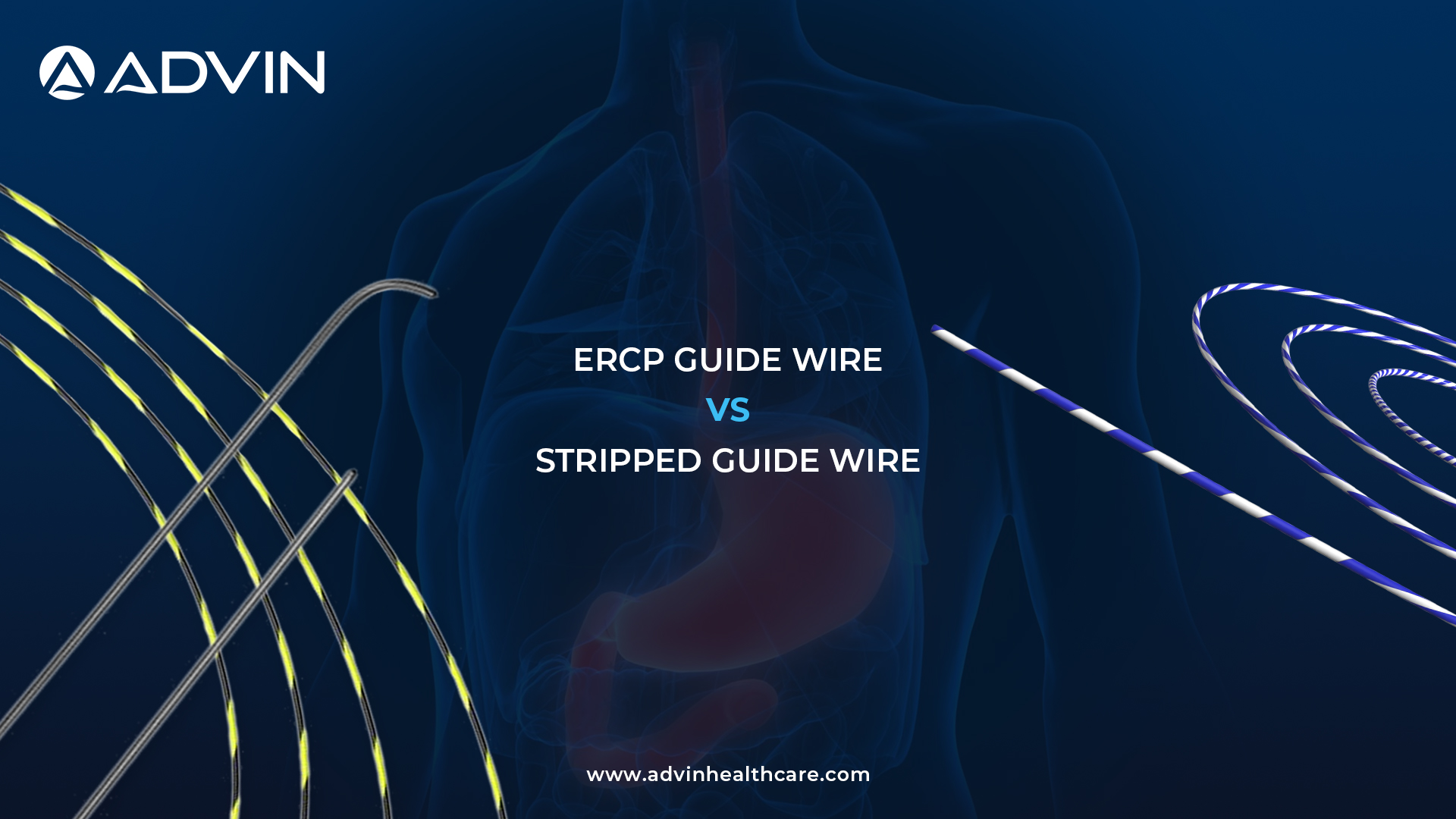
Introduction: Why Guidewire Selection Impacts ERCP Success
Guidewires are the backbone of ERCP procedures, enabling access, navigation, and device placement within the biliary or pancreatic ducts. While both ERCP Guidewire and Stripped Guidewire are used in the same procedure, their roles differ based on the stage of intervention. During ERCP, a guidewire is first used to access the duct and then to support device exchange such as sphincterotomes, dilators, or stents. Choosing the right type at the right time improves control and procedural efficiency. This blog explains how each guidewire contributes to a smooth workflow.
Device Role Across Procedure Stages
ERCP Guidewire (Hydrophilic Guidewire)
Advin Health Care’s ERCP Guidewire is primarily used for initial duct access and navigation. It features a hydrophilic coated tip that allows smooth entry through the papilla and easy passage across strictures. This makes it ideal for reaching the target site with minimal resistance during the early phase of the procedure.
Stripped Guidewire (Hydrophilic Stripped Wire)
Advin Health Care’s Stripped Guidewire is designed for device exchange and enhanced control. It has a partially removed outer coating, which improves grip and stability when advancing accessories over the wire. This is particularly useful once access is achieved and precise handling is required.
Workflow-Based Usage: Sequential, Not Substitutes
These guidewires are used at different points in the same procedure.
ERCP Guidewire is typically the starting tool, helping achieve smooth and atraumatic duct access. Once access is secured, Stripped Guidewire is often preferred for better control during device exchange, especially in complex or tight anatomies.
Key distinctions include:
- ERCP Guidewire → Smooth navigation and entry
- Stripped Guidewire → Stability and control
- Hydrophilic tip → Easier duct access
- Stripped surface → Better device grip
Quick Comparison Overview
| Aspect | ERCP Guidewire | Stripped Guidewire |
| Primary Role | Access & navigation | Device exchange & control |
| Surface | Fully hydrophilic coated | Partially stripped coating |
| Handling | Smooth and flexible | Firm and stable |
| Usage Stage | Initial phase | Intermediate / advanced phase |
| Control Level | Moderate | High |
| Ideal Use | Cannulation & passage | Accessory support |
Clinical Preference & Real-World Application
Advin ERCP Guidewire is widely used at the beginning of procedures due to its smooth glide and ability to cross difficult segments with minimal trauma. It simplifies duct cannulation and reduces resistance.
Advin Stripped Guidewire becomes valuable once the pathway is established. It provides better support while introducing devices like stents or dilators, ensuring controlled movement and reducing slippage.
Practical Selection Guide
- Start with Advin ERCP Guidewire for duct access
- Switch to Advin Stripped Guidewire for device exchange
- Use hydrophilic wire for smooth entry
- Use stripped wire for better control
Why Advin Health Care is the Right Choice
Advin Health Care provides a comprehensive range of ERCP guidewires designed for real clinical demands. Advin ERCP Guidewires are engineered for smooth navigation, optimal flexibility, and reliable duct access.
Advin Health Care’s Stripped Guidewires are built to deliver enhanced grip and stability during advanced procedural steps. With Advin, healthcare providers benefit from consistent quality, dependable performance, and solutions that support every stage of ERCP procedures.
Get Connected:
+91-75037 27250 | gastrology@advinhealthcare.com | www.advinhealthcare.com