
 English
 Afrikaans
 Albanian
 Amharic
 Arabic
 Armenian
 Azerbaijani
 Basque
 Belarusian
 Bengali
 Bosnian
 Bulgarian
 Catalan
 Cebuano
 Chichewa
 Chinese (Simplified)
 Chinese (Traditional)
 Corsican
 Croatian
 Czech
Czech Danish
 Dutch
Dutch Esperanto
 Estonian
 Filipino
 Finnish
 French
 Frisian
 Galician
 Georgian
 German
 Greek
Greek Gujarati
 Haitian Creole
 Hausa
Hausa Hawaiian
 Hebrew
 Hindi
Hindi Hmong
Hmong Hungarian
 Icelandic
 Igbo
Igbo Indonesian
 Irish
Irish Italian
 Japanese
 Javanese
 Kannada
 Kazakh
 Khmer
Khmer Korean
 Kurdish (Kurmanji)
 Kyrgyz
 Lao
Lao Latin
Latin Latvian
 Lithuanian
 Luxembourgish
 Macedonian
 Malagasy
 Malay
Malay Malayalam
 Maltese
 Maori
Maori Marathi
 Mongolian
 Myanmar (Burmese)
 Nepali
 Norwegian
 Pashto
 Persian
 Polish
 Portuguese
 Punjabi
 Romanian
 Russian
 Samoan
 Scottish Gaelic
 Serbian
 Sesotho
 Shona
Shona Sindhi
 Sinhala
 Slovak
 Slovenian
 Somali
 Spanish
 Sudanese
 Swahili
 Swedish
 Tajik
Tajik Tamil
Tamil Telugu
 Thai
Thai Turkish
 Ukrainian
 Urdu
Urdu Uzbek
Uzbek Vietnamese
 Welsh
Welsh Xhosa
Xhosa Yiddish
 Yoruba
 Zulu
Zulu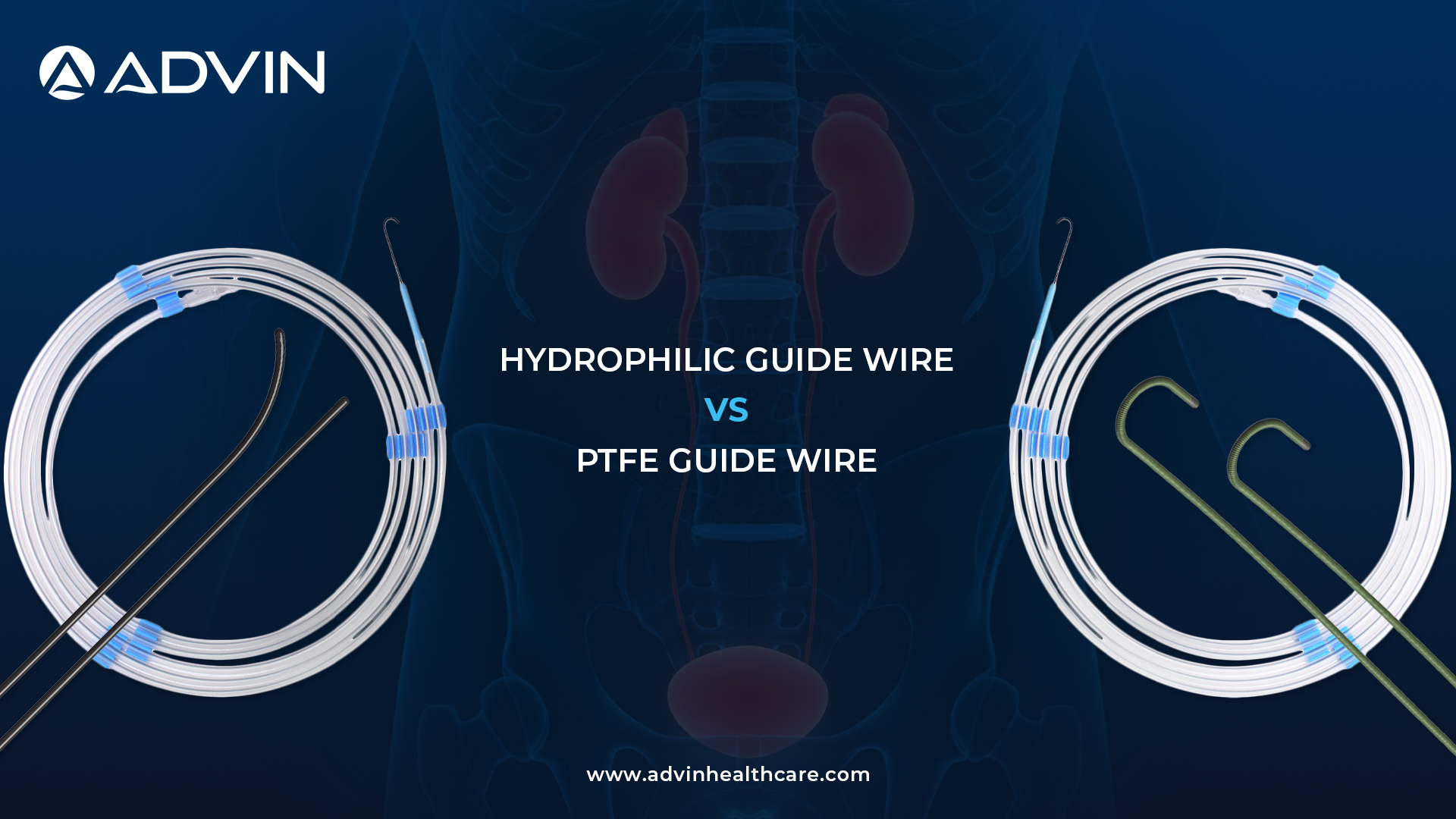
Introduction: Surface Technology Defines Guidewire Performance
Guidewires are essential tools in urology and endourology procedures, enabling access, navigation, and device placement within the urinary tract. The performance of a guidewire largely depends on its surface coating and friction characteristics.
Two commonly used types—Hydrophilic Guidewire and PTFE Guidewire—differ significantly in lubricity, control, and clinical application.
Product Overview in Clinical Use
Hydrophilic Guidewire
Hydrophilic guidewires are coated with a water-activated polymer that becomes extremely slippery when wet.
Key characteristics:
- Hydrophilic coating (activated by fluid)
- Very low friction surface
- Highly flexible tip
Clinical advantages:
- Smooth navigation through tight or tortuous anatomy
- Easier crossing of strictures and obstructions
- Reduced trauma to tissues
They are commonly used in initial access and complex navigation cases.
PTFE Guidewire (Teflon-Coated Guidewire)
PTFE (Polytetrafluoroethylene) guidewires are coated with a low-friction, non-stick material.
Key characteristics:
- PTFE (Teflon) coating
- Moderate smoothness
- Balanced stiffness and control
Clinical advantages:
- Better tactile feedback
- Enhanced control during device exchange
- Stable positioning
They are widely used in routine procedures and device support stages.
Workflow-Based Usage: Glide vs Control
Both guidewires are used in the same procedures but at different stages:
- Hydrophilic Guidewire → Smooth entry and navigation
- PTFE Guidewire → Stability and control during device handling
This affects:
- Ease of access
- Precision of movement
- Procedural efficiency
Core Differences That Drive Clinical Choice
The key difference lies in surface friction and handling characteristics:
- Hydrophilic guidewire offers maximum lubricity and flexibility
- PTFE guidewire provides better control and tactile feedback
Quick Comparison Overview
| Aspect | Hydrophilic Guidewire | PTFE Guidewire |
| Coating | Hydrophilic polymer | PTFE (Teflon) |
| Surface Friction | Very low (slippery when wet) | Low |
| Flexibility | High | Moderate |
| Tactile Feedback | Low | High |
| Navigation | Excellent in tight anatomy | Moderate |
| Control | Moderate | High |
| Usage Stage | Initial access | Device exchange / support |
| Clinical Use | Complex cases | Routine procedures |
Clinical Preference & Real-World Application
Hydrophilic Guidewire is commonly used in:
- Difficult cannulation
- Tight strictures or obstructions
- Complex anatomical pathways
Its lubricity allows smooth and atraumatic navigation.
PTFE Guidewire is preferred in:
- Routine procedures
- Device exchange and support
- Situations requiring precise control
Its structure ensures stable positioning and better handling.
Practical Selection Guide
- Choose Hydrophilic Guidewire for smooth access and complex navigation
- Choose PTFE Guidewire for control and device support
- Use hydrophilic wire for entry phase
- Use PTFE wire for stability and procedural control
Conclusion: Smooth Navigation vs Precise Control
Both guidewires are essential and often used together:
- Hydrophilic → Glide, flexibility, and easy access
- PTFE → Control, stability, and precision
The best results are achieved by selecting the right guidewire based on procedure stage and clinical need.
Why Advin Health Care is the Right Choice
Advin Health Care offers a complete range of guidewires designed for precision and performance.
- Hydrophilic guidewires ensure smooth navigation and easy access
- PTFE guidewires provide stable control and reliable support
With Advin, healthcare providers benefit from:
- Advanced coating technology
- Consistent performance
- Solutions tailored for every stage of endourological procedures
Get Connected:
+91-70717 27261 | urology@advinhealthcare.com | www.advinhealthcare.com